Ai/ml
AI Agents vs Chatbots vs Workflow Automation: What Your Business Actually Needs
- Oct 8, 2026

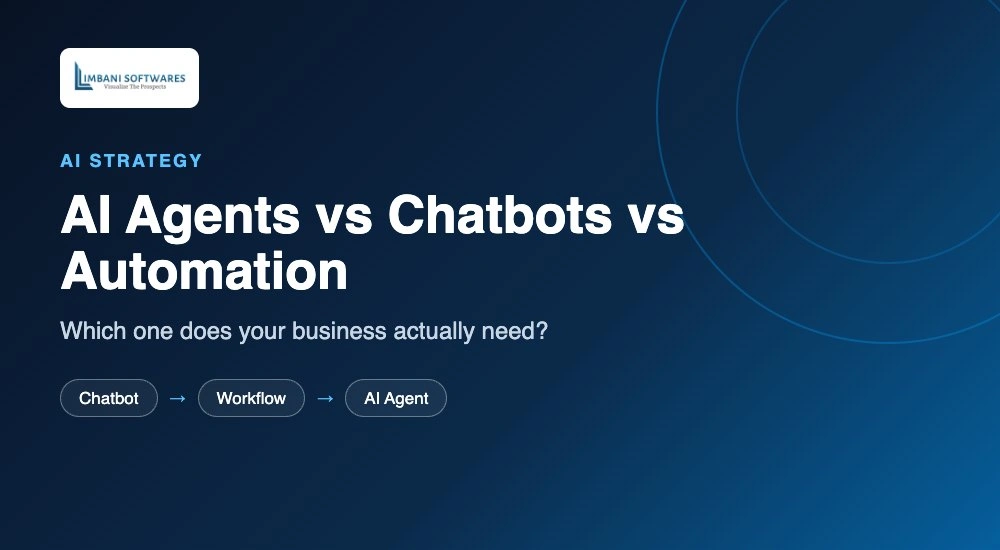
A chatbot answers questions, workflow automation follows fixed rules, and an AI agent plans and completes multi-step tasks using tools and judgement. Most businesses don't need to pick just one: the best results usually come from using rules for predictable steps, a chatbot for conversations, and an agent only where real decisions are needed.
"AI agent" became one of the most-hyped terms in software in 2025 and 2026, and many products now use the label loosely. This guide cuts through it with plain definitions, a decision guide, real examples from projects we have built, and the risks to plan for before you invest.
•Chatbot. Software that holds a conversation. A modern AI chatbot understands natural language and can answer from your own documents, but it mainly responds it doesn't run a process on its own.
•Workflow automation. A fixed sequence of steps triggered by an event: when a form is submitted, create a CRM record and send an email. Tools like n8n or Zapier excel here. It is fast, cheap and predictable, but breaks when inputs are messy.
•AI agent. Software that uses a large language model to decide which steps to take and calls tools APIs, databases, email, calendars to complete a goal. It can handle unstructured inputs and changing situations, at the cost of more design, testing and monitoring.
Use this rule of thumb: start with the simplest option that solves the problem, and add intelligence only where the simple option fails.
•the steps are the same every time;
•inputs are structured (forms, spreadsheets, API events);
•mistakes must be near zero and fully predictable.
•customers or employees ask many similar questions;
•answers live in documents, FAQs or a knowledge base;
•a person should take over complex conversations.
•the task has several steps that depend on what happened before;
•inputs are unstructured emails, documents, calls, web pages;
•the work today needs a person's judgement but follows a recognisable pattern.
Here is how these approaches show up in our projects and published solution blueprints:
•AI receptionist (voice agent + automation). For a salon chain we built an AI receptionist that answers calls, books appointments and hands off to staff, with n8n workflows handling the predictable follow-up steps.
•AI content writing system (multi-agent blueprint). In this solution blueprint, specialised agents research, draft and review content, with a human approval step before anything is published.
•AI SEO/GEO visibility agent (blueprint). A blueprint for an agent that audits pages and tracks how a brand appears in search and AI answers, turning findings into prioritised actions.
•AI resume screening (AI step inside a workflow). Scan2Hire uses AI to read and score resumes inside a structured hiring workflow, so recruiters review a ranked shortlist instead of every application.
•Wrong actions. An agent with broad permissions can make costly mistakes. Give each tool the minimum access it needs and require human approval for high-impact actions.
•Hallucinations. Ground agents in your own data and validate outputs before they are used.
•Prompt injection. Content the agent reads (emails, web pages) can contain malicious instructions. Treat external content as untrusted.
•Runaway cost and latency. Multi-step agents can call a model many times. Set limits, cache results and monitor cost per task.
•No visibility. Log every step so you can debug failures and prove what the agent did.
•1. Pick one painful, repetitive process. High volume, clear success criteria, easy to check.
•2. Automate the predictable parts first. Rules and integrations often deliver most of the value.
•3. Add AI where judgement is needed. Classification, extraction, drafting or deciding the next step.
•4. Keep a human in the loop at first. Review outputs, measure accuracy, then reduce reviews as confidence grows.
•5. Measure and expand. Track time saved and errors, then move to the next workflow.
AI agents are powerful, but they are not always the right tool. The winning pattern is usually a blend: automation for the fixed steps, a chatbot for conversations, and an agent where decisions are needed all with guardrails and measurement.
If you are deciding between these options, talk to our AI agent development team, or explore our AI chatbot development and AI automation services. We usually start with a small proof of concept, and projects start from $1,000.