Ai/ml
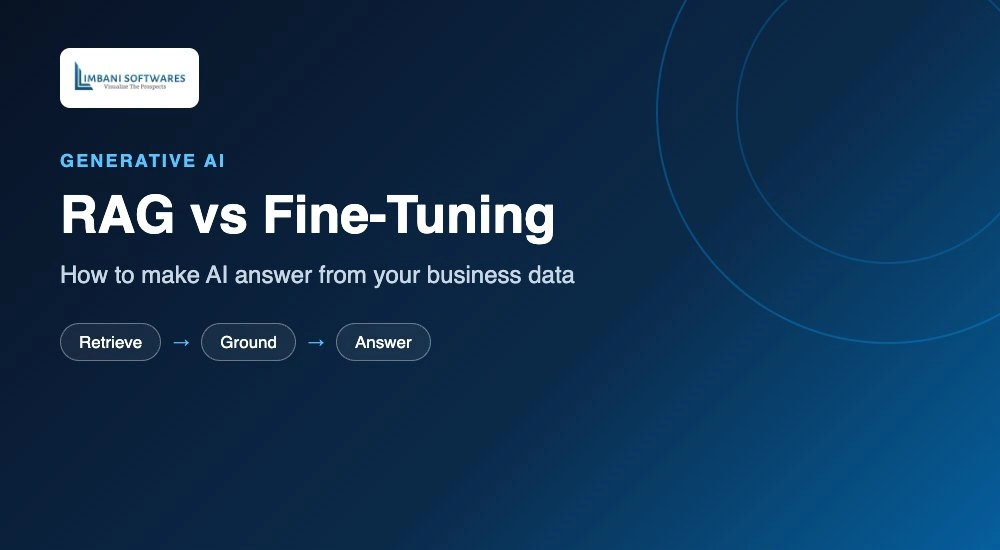
RAG vs Fine-Tuning: How to Make AI Answer From Your Business Data
- Oct 8, 2026

Use RAG (retrieval-augmented generation) when you want AI to answer from your own, changing business information documents, policies, product data with sources you can check. Use fine-tuning when you need a model to consistently follow a style, format or narrow task. For most business chatbots and assistants, RAG is the right first step: it is cheaper, faster to update and easier to trust.
Both techniques solve the same frustration: general AI models don't know your business. This guide explains how each works in plain English, compares them side by side, and shows when combining them makes sense.
RAG adds a search step before the AI answers. Your content is split into passages and indexed. When a user asks a question, the system retrieves the most relevant passages and gives them to the language model with an instruction to answer only from that context, ideally with citations.
Because the knowledge lives outside the model, you update the AI's knowledge by updating your documents no retraining needed.
Fine-tuning continues training a model on your own examples so it changes its behaviour: always replying in a certain format, using your terminology, classifying tickets the way your team does, or matching your brand voice. The knowledge is baked into the model's weights.
Fine-tuning is good at teaching patterns, but it is a poor way to store facts that change often, and it can't show where an answer came from.
•Best for. RAG: answering from specific, changing information. Fine-tuning: consistent style, format or a narrow task.
•Keeping knowledge current. RAG: update documents and re-index. Fine-tuning: prepare new data and retrain.
•Citations and traceability. RAG: can cite the source passage. Fine-tuning: cannot point to a source.
•Data needed. RAG: your existing documents. Fine-tuning: hundreds or more high-quality labelled examples.
•Access control. RAG: can filter what each user retrieves. Fine-tuning: everything learned is available to every user of the model.
•Typical cost to start. RAG: lower no training runs. Fine-tuning: higher data preparation, training and evaluation.
•A customer support chatbot that answers from your help centre and policies.
•An internal assistant that searches SOPs, contracts or technical documentation.
•A sales assistant that answers product and pricing questions accurately.
•Any use case where people need to verify the answer against a source.
•You need outputs in a strict format every time, and prompting alone isn't reliable enough.
•You have a narrow classification or extraction task with many labelled examples.
•You want a smaller, cheaper model to match the quality of a larger one on one specific task.
•Your brand voice or domain language is distinctive and important.
Yes. A common pattern is a fine-tuned model for tone and format, with RAG supplying the facts. In practice we recommend starting with good prompting plus RAG, measuring quality on real questions, and only fine-tuning if a clear gap remains.
•Clean, well-chunked content. Retrieval is only as good as the documents behind it.
•Hybrid search and re-ranking. Combine meaning-based and keyword search to find the right passages.
•Grounded prompts. Instruct the model to answer only from retrieved context and say when it doesn't know.
•Citations. Show sources so users can check answers.
•Evaluation and monitoring. Test on real questions before launch and review answers in production.
For most businesses, RAG is the fastest and safest way to make AI useful with company knowledge. Fine-tuning is a specialist tool for style and narrow tasks. Start with RAG, measure, and fine-tune only when the data shows you need it.
Our RAG development and LLM integration services can help you build a proof of concept on your own data, starting from $1,000.