Seo
Is SEO Dead in 2026? How AI Search Changes SEO, AEO and GEO
- Oct 8, 2026

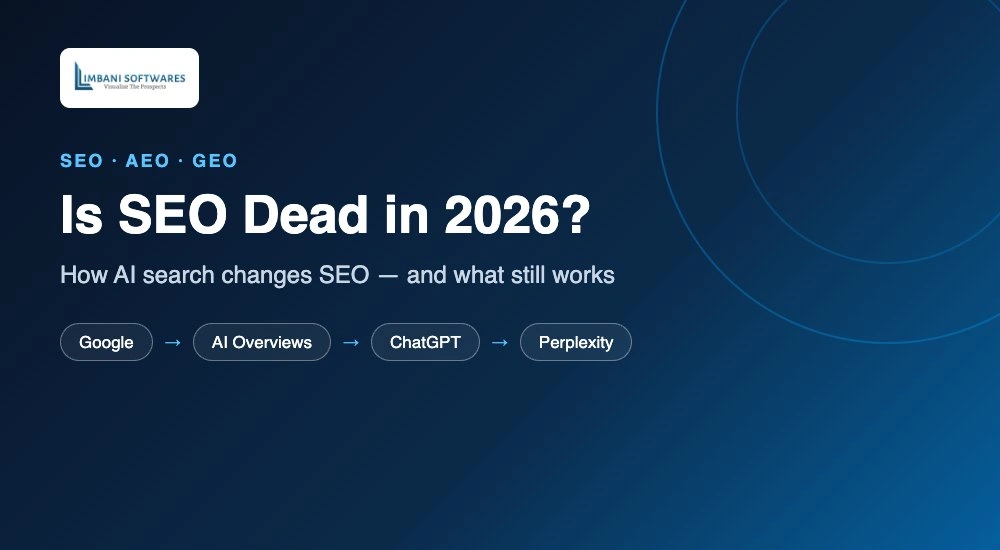
No, SEO is not dead in 2026 but the way people find answers has changed. Google now shows AI Overviews and AI Mode, and millions of people ask ChatGPT, Perplexity, Gemini or Copilot instead of scrolling ten blue links. Those AI systems still have to find, crawl and trust web pages before they can quote them. SEO has become the foundation for two new disciplines: AEO (answer engine optimisation) and GEO (generative engine optimisation).
Google says this directly in its guidance on AI features: the same SEO best practices still apply, and there are no special tricks required to appear in AI Overviews. You can read it in Google's AI features and your website documentation.
This guide explains what actually changed, what SEO, AEO and GEO mean in practice, and a checklist you can apply to your own website the same approach we use on our own site and for clients.
Three shifts matter for businesses. First, search engines now answer many questions directly on the results page with AI-generated summaries, so some simple informational queries send fewer clicks. Second, AI assistants with web search cite a handful of sources per answer, so being one of those sources matters more than ranking ninth. Third, buyers increasingly research vendors by asking AI tools questions like "best AI development company for a healthcare startup" and shortlisting whoever is mentioned.
None of this removes the need for crawlable, trustworthy pages. It raises the bar: thin, generic pages lose, while specific, well-structured pages that clearly answer questions win both rankings and citations.
They are layers of the same work rather than competing strategies.
•SEO (search engine optimisation). Making pages crawlable, fast, well-structured and relevant so they rank in search results.
•AEO (answer engine optimisation). Writing content so a clear, self-contained answer can be lifted into featured snippets, People Also Ask boxes, voice assistants and AI summaries.
•GEO (generative engine optimisation). Building the authority and consistent entity information that make AI systems like ChatGPT, Perplexity and Gemini trust and cite your brand including third-party mentions, reviews and case studies.
The fundamentals carry more weight, not less, because AI systems retrieve from the same index.
•Server-rendered content. If your text, FAQs or links only appear after JavaScript runs, crawlers and AI bots may never see them. Important content should be in the initial HTML.
•Clear page structure. One descriptive H1, logical H2s phrased like real questions, and short paragraphs make pages easy to parse and quote.
•Technical hygiene. Clean canonical URLs, an accurate XML sitemap, real 404s, fast load times and HTTPS still decide whether pages get indexed at all.
•Structured data that matches the page. Organization, Service, Article, FAQPage and BreadcrumbList schema help machines understand entities but only when the marked-up content is visible on the page.
•Helpful, specific content. Google's helpful-content guidance rewards content written for people, showing first-hand experience, over pages written to match keywords.
AI summaries and snippets favour content that answers a question directly and can stand on its own.
Put a 40–60 word direct answer right after the heading that asks the question, then add detail, examples and trade-offs below it. This is the pattern we use in the "Quick answer" sections across our own service pages.
Turn the questions your sales team hears cost, timeline, which technology, how to choose a vendor into H2s. Each one is a chance to be the quoted answer.
A short FAQ block with clear, factual answers helps both people and answer engines. Mark it up with FAQPage schema only if the questions are visible on the page.
Comparison tables, numbered steps and "when not to use this" sections are easy for AI systems to extract and are often more useful to readers than long paragraphs.
Generative engines cite sources they can access and trust. A few practical steps make a measurable difference over time:
•Let the right crawlers in. Make sure robots.txt does not block search and AI crawlers such as Googlebot, Bingbot and OAI-SearchBot. ChatGPT search, for example, relies on OpenAI's search crawler to discover pages.
•Keep facts consistent everywhere. Your company name, founding year, location, services and numbers should match on your website, LinkedIn, Clutch, Google Business Profile and directories. Contradictions reduce trust.
•Publish proof, not slogans. Case studies with the problem, approach, architecture and outcome are far more citable than "we build innovative solutions".
•Earn third-party mentions. Reviews, interviews, guest articles and genuine community answers give AI systems independent evidence about who you are.
•Track AI visibility. Each month, ask AI assistants the questions your buyers ask and record whether you are mentioned, which page is cited and whether the information is accurate.
•Every important page has one clear H1 and a direct answer in the first 100 words.
•Main content, FAQs, footer and navigation links are present in the server HTML.
•Canonical URLs, sitemap URLs and internal links all use the same format.
•Structured data validates and matches what visitors can see.
•Company facts are identical across the site and third-party profiles.
•Service pages link to related case studies, and case studies link back to services.
•Old URLs redirect with a 301 to the closest relevant page, never all to the homepage.
•Search Console and Bing Webmaster Tools are set up, and AI citations are reviewed monthly.
SEO in 2026 is less about chasing keywords and more about being the clearest, most trustworthy answer on the web. Get the technical foundation right, structure content so answers are easy to extract, and build real evidence and consistent facts about your business. That combination works for Google rankings, AI Overviews and AI assistants alike.
If you want your website rebuilt or upgraded with this approach, our web development team builds server-rendered, SEO-ready sites, and our AI services include AI agents that monitor SEO and AI visibility see our AI SEO/GEO visibility agent blueprint.