

How We Build an AI Agent for SEO, GEO and AEO Visibility Tracking
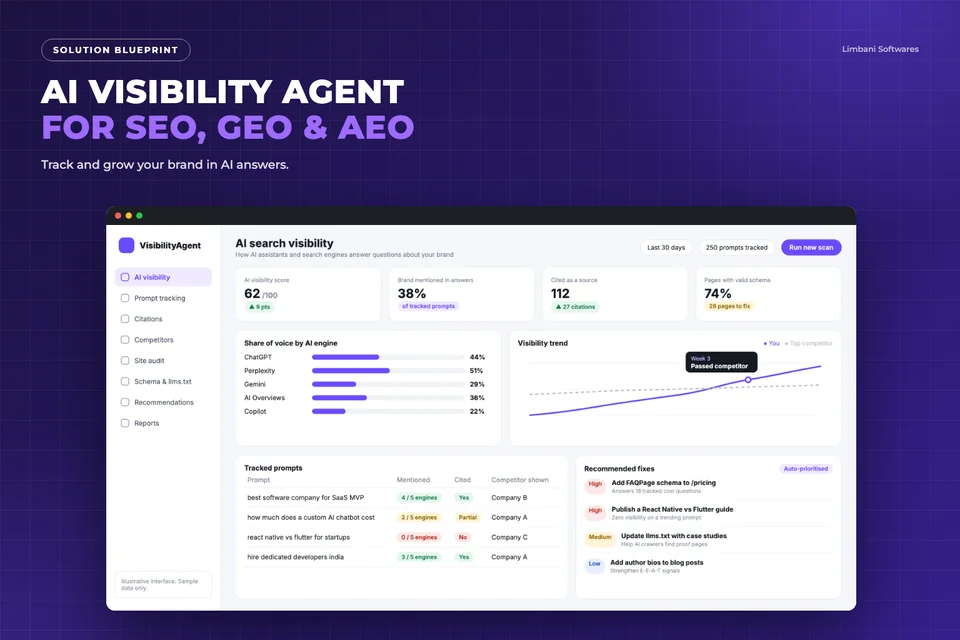
Buyers now ask ChatGPT, Perplexity, Gemini and Google AI Overviews for recommendations before they visit a website. GEO (generative engine optimisation) and AEO (answer engine optimisation) are the practices of making a brand visible and cited in those answers. This solution blueprint shows how Limbani Softwares builds an AI visibility agent that runs real buyer questions across AI engines, tracks brand mentions and citations, audits the website for schema and answer-first content, and recommends the fixes with the biggest impact.
Type
Solution Blueprint
Use Case
SEO, GEO & AEO Analytics
Engines
ChatGPT, Perplexity, Gemini, AI Overviews
Core Stack
Python, LLM APIs, PostgreSQL
The Solution
One agent covers classic SEO, answer engines and generative AI search, so marketing teams can see where the brand appears, why competitors win and exactly what to fix next.
AI Answer Tracking
A library of real buyer questions is run on a schedule across major AI assistants and search results to see which brands are mentioned and recommended.
Citation Monitoring
The agent records which URLs AI engines cite, so teams know which pages earn trust and which need work.
Competitor Share of Voice
Visibility is compared against competitors for every prompt, engine and topic, showing exactly where the brand is losing ground.
Technical and Content Audit
Pages are checked for schema such as FAQPage, HowTo and Article, answer-first structure, llms.txt, speed and E-E-A-T signals.
Prioritised Recommendations
Every gap becomes a clear task ranked by impact and effort, with suggested content briefs and JSON-LD snippets.
Reports and Alerts
Weekly reports and alerts for visibility drops or new competitors keep marketing and leadership informed.
Technologies & Tools
Python agents with LLM and search APIs, a site crawler, n8n scheduling, PostgreSQL and vector storage, and a Next.js visibility dashboard.


Development Process
The development process involved the following stages:

Discovery

Prompt Library

Data Collection

Analysis Agents

Validation

Launch & Reporting
Why Do Brands Need to Track AI Search Visibility?
Search behaviour is changing. Many buyers now get their shortlist from an AI assistant or an AI Overview rather than a list of blue links. If a brand is not mentioned or cited in those answers, it can lose deals without ever seeing the search. Traditional SEO tools measure rankings and clicks, but they do not show what AI assistants say about a brand, which sources they trust or which competitors they recommend. Marketing teams need a way to measure this new visibility and improve it systematically.
How Does the AI Visibility Agent Work?
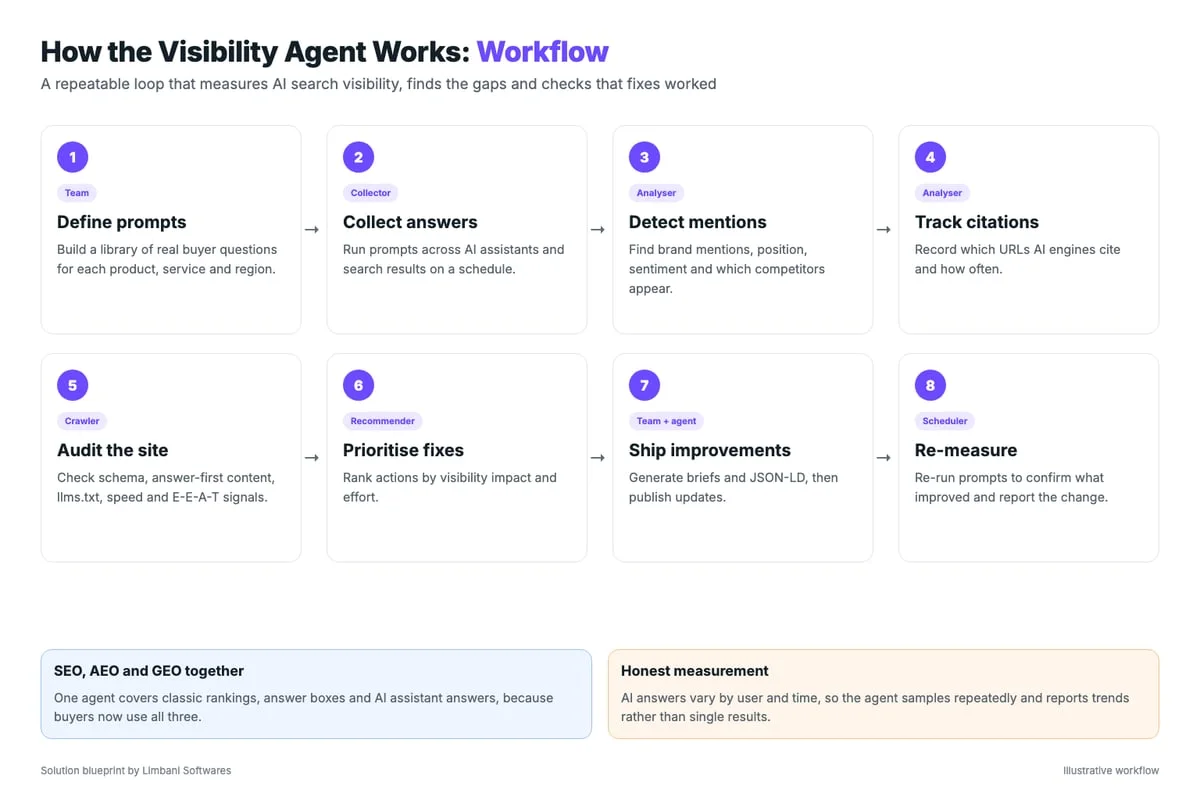
The team defines a library of real buyer questions for each product, service and region. Collector agents run these prompts on a schedule across AI assistants and search results and store every answer. Analysis agents detect brand mentions, position, sentiment and competitor presence, and track which URLs are cited. A crawler audits the website for schema, answer-first content, llms.txt and trust signals. The recommender ranks fixes by impact, generates briefs and JSON-LD, and after changes ship, the agent re-runs the prompts to confirm what improved.
What Is the Architecture and Tech Stack?
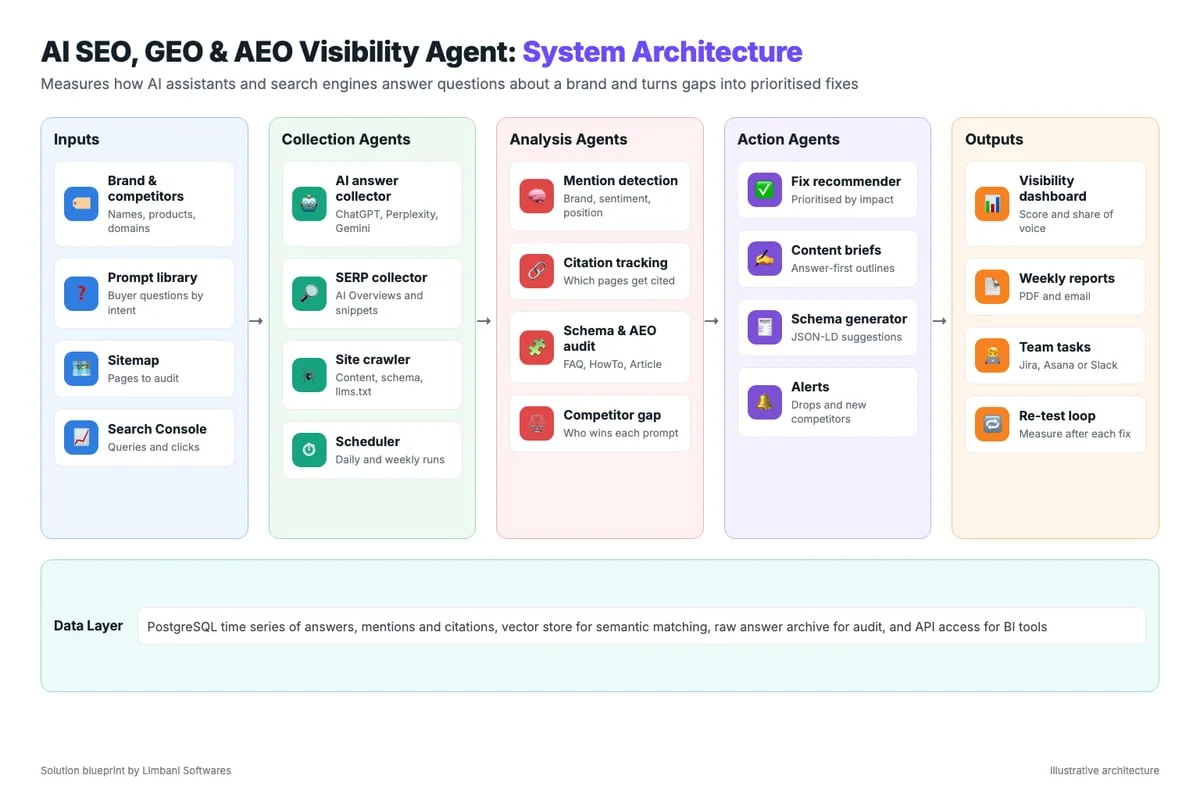
The agent is built in Python with separate collection, analysis and action agents coordinated by a scheduler such as n8n. It uses official LLM and search APIs to gather answers, a crawler for site audits, and LLMs for mention detection and recommendations. PostgreSQL stores answers, mentions and citations as a time series, with a vector store for semantic matching and a raw answer archive for audit. A Next.js dashboard shows visibility scores, share of voice and tasks, and reports can be sent by email or pushed to tools like Slack, Jira or Asana. Because AI answers vary by user and time, the agent samples repeatedly and reports trends rather than single results.